



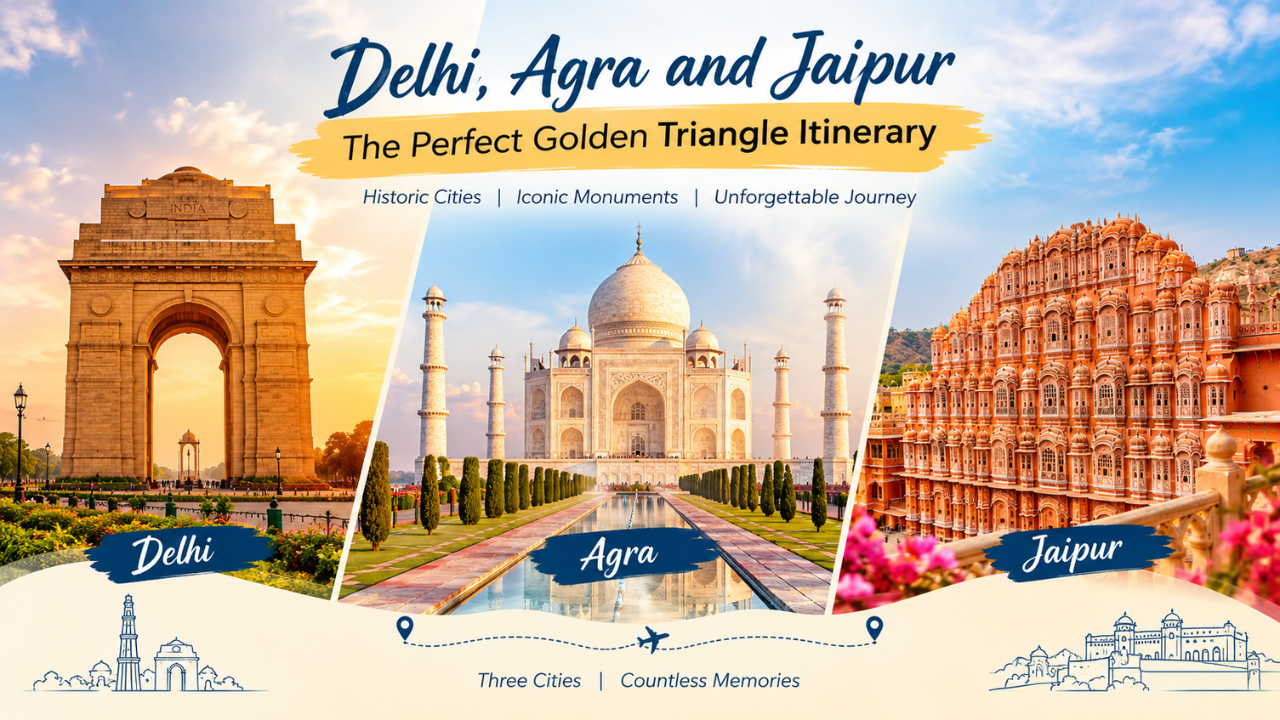
Planning a holiday that combines India’s history, royal architecture, cultural experiences, and famous monuments? A well-designed Golden Triangle Tour Itinerary in India is an excellent way to explore three remarkable cities: Delhi, Agra, and Jaipur. This popular travel circuit introduces visitors to Mughal heritage, magnificent forts, traditional markets, delicious local food, and the diverse traditions of northern India.
Whether you are travelling with family, planning a romantic holiday, or visiting India for the first time, the Golden Triangle Tour Itinerary in India offers a memorable travel experience. You can explore Delhi’s historic landmarks, admire the Taj Mahal in Agra, and discover Jaipur’s colourful palaces and forts in one journey.
From choosing the right duration to comparing tour packages, transportation, and accommodation, proper planning makes your trip more comfortable. In this guide, we explain how to organise your journey, which attractions to prioritise, and how to choose a suitable tour.
What Is the Golden Triangle in India?
The Golden Triangle connects Delhi, Agra, and Jaipur, three destinations known for their historical importance and distinctive architecture. These cities form a triangular route on the map and are among India’s most popular destinations for cultural tourism.
Delhi offers a combination of historical monuments, lively markets, and modern attractions. Agra is famous for the Taj Mahal and its Mughal heritage, while Jaipur showcases Rajasthan’s royal traditions through its forts, palaces, and traditional bazaars.
If you are researching what is golden triangle india, it is essentially a travel circuit that allows visitors to experience three important cultural destinations in one holiday.
This route is particularly suitable for international travellers, couples, families, and history enthusiasts. You can plan the journey independently or work with a professional tour operator to arrange accommodation, transportation, sightseeing, and guided experiences.
Travellers interested in heritage tours can also discover historic destinations and cultural attractions beyond the main circuit.
Why Choose a Golden Triangle Tour Itinerary in India?
The main advantage of a Golden Triangle Tour Itinerary in India is its combination of convenience, historical attractions, and cultural experiences. Instead of spending your entire holiday in one location, you can explore three cities with different traditions and architectural styles.
Here are some reasons to consider this route:
- Historical monuments: Visit the Red Fort, Taj Mahal, Agra Fort, and Amber Fort.
- Cultural experiences: Discover local food, traditional markets, and regional handicrafts.
- Architectural diversity: Explore Mughal monuments, Rajput palaces, and historic observatories.
- Flexible travel options: Choose road transfers, trains, or a combination of transport.
- Different budgets: Select economical accommodation or premium hotels and private transfers.
- Convenient planning: Choose a shorter itinerary or spend additional days exploring each destination.
The route also suits travellers who want a structured introduction to India’s history and culture. With suitable planning, a Golden Triangle Tour Itinerary in India can balance sightseeing with shopping, food experiences, and relaxation.
Golden Triangle Itinerary in India: A Five-Day Travel Plan
Five days provide a practical introduction to the three cities, although the schedule depends on your arrival time and sightseeing preferences.
| Day | Destination | Recommended activities | Overnight stay |
| Day 1 | Delhi | India Gate, Humayun’s Tomb, Qutub Minar | Delhi |
| Day 2 | Delhi to Agra | Taj Mahal, Agra Fort | Agra |
| Day 3 | Agra to Jaipur | Travel to Jaipur, optional Fatehpur Sikri visit | Jaipur |
| Day 4 | Jaipur | Amber Fort, Hawa Mahal, City Palace | Jaipur |
| Day 5 | Jaipur | Jantar Mantar, local markets, departure | Departure city |
This Golden Triangle Tour Itinerary in India covers the principal attractions without requiring a different hotel every night. If you prefer a slower pace, extend your holiday to six or seven days.
Day 1: Explore Delhi’s Historical Attractions
Start your journey in Delhi, India’s capital, which combines centuries of history with modern urban life.
Visit India Gate, a prominent war memorial, before exploring Humayun’s Tomb, a UNESCO World Heritage Site known for its Mughal architecture and landscaped gardens. Continue to Qutub Minar if your schedule allows.
You can also explore Old Delhi, where Chandni Chowk offers a lively atmosphere, traditional shops, local snacks, and historic streets. A guided walking tour can help you understand the area’s cultural significance.
For additional sightseeing ideas, explore our Delhi destination guide, which can help you identify attractions to include in your travel plans.
Recommended experiences in Delhi:
- Explore historic monuments and architectural landmarks.
- Discover traditional markets and local street food.
- Learn about Mughal and colonial history.
- Enjoy a guided cultural walk through Old Delhi.
Choose accommodation with convenient access to transport connections and your planned attractions. Delhi has options for different budgets, from guesthouses to luxury hotels.
Day 2: Travel to Agra and Visit the Taj Mahal
On the second day, travel from Delhi to Agra. The journey usually takes around three to four hours by road, although traffic and departure points can affect the duration. Trains are another convenient option.
The Taj Mahal should be the highlight of your Agra visit. Commissioned by Mughal emperor Shah Jahan in memory of Mumtaz Mahal, this white marble monument is admired for its symmetry, detailed craftsmanship, and gardens.
Allow sufficient time to explore the complex and appreciate its architectural details. Check official visiting information before your trip because the Taj Mahal is generally closed to visitors on Fridays.
Next, visit Agra Fort, another important historical landmark featuring courtyards, palaces, and imposing fortifications. If time permits, explore local markets for marble handicrafts, textiles, and souvenirs.
Our Agra destination guide can help you explore additional attractions and decide whether to extend your stay.
A successful Golden Triangle Tour Itinerary in India should allow enough time to enjoy Agra rather than treating the city as a brief stop for photographs.
Day 3: Travel from Agra to Jaipur
After breakfast, leave Agra for Jaipur, the capital of Rajasthan. The road journey typically takes around four to five hours, depending on traffic, road conditions, and sightseeing stops.
If your schedule allows, visit Fatehpur Sikri, a historic Mughal city recognised as a UNESCO World Heritage Site. Important structures include Buland Darwaza, Jama Masjid, and the complex associated with Salim Chishti.
Remember that this stop adds sightseeing time, so plan your departure accordingly.
After arriving in Jaipur, check into your hotel and spend the evening exploring nearby markets or enjoying traditional Rajasthani cuisine. Dishes such as dal baati churma and ghewar are popular choices for visitors.
If you want to combine historical sightseeing with wildlife experiences, consider comparing this four-day Golden Triangle tour with Ranthambore safari. Check the itinerary carefully because the shorter duration means you will need to prioritise activities.
Day 4: Discover Jaipur’s Royal Heritage
Jaipur, popularly known as the Pink City, is famous for its royal architecture, colourful markets, and traditional crafts.
Begin with Amber Fort, situated outside the main city. Explore its courtyards, decorative halls, and impressive gateways, which reflect Rajput architectural traditions and historical influences.
Continue to Hawa Mahal, recognised for its distinctive façade and numerous small windows. Then visit City Palace to discover its courtyards, museums, and royal heritage.
Jantar Mantar is another worthwhile attraction. This UNESCO World Heritage Site contains historic astronomical instruments used to observe celestial movements.
For further sightseeing ideas, visit our Jaipur destination guide before finalising your schedule.
Spend the afternoon exploring local markets. Johari Bazaar is known for jewellery, while Bapu Bazaar offers textiles, clothing, and souvenirs. Compare prices and check product quality before purchasing handicrafts.
Jaipur adds a distinctive cultural dimension to your Golden Triangle Tour Itinerary in India, making it particularly appealing to travellers interested in architecture, history, shopping, and traditional cuisine.
Day 5: Enjoy Jaipur and Complete Your Journey
Use your final morning to explore any attractions you missed. Depending on your departure time, you could revisit a market, enjoy a traditional breakfast, or visit a museum.
Leave sufficient time for your airport or railway station transfer. Traffic can be unpredictable, so avoid scheduling too many activities before departure.
If you prefer a more relaxed holiday, consider extending your stay or choosing a longer itinerary. A seven-day journey provides additional time for sightseeing and a less rushed experience.
You can compare this seven-day all-inclusive Golden Triangle tour if you want a longer trip with more time for exploring the destinations.
Golden Triangle Travel: Transportation and Travel Time
Choosing suitable transportation is important because your travel experience depends on both sightseeing and the time spent between cities.
| Route | Approximate road travel time | Alternative |
| Delhi to Agra | 3–4 hours | Train |
| Agra to Jaipur | 4–5 hours | Train or private transfer |
| Jaipur to Delhi | 5–6 hours | Train |
These are estimates, not guaranteed journey times. Traffic, weather, departure points, and road conditions can affect your schedule.
For comfortable golden triangle travel, private transfers provide flexibility and can be useful for families and groups. Trains can be suitable for travellers who prefer scheduled departures and want to reduce road travel.
Book transport in advance during busy travel periods and confirm pickup points, luggage arrangements, and station transfers.
Best Time to Visit the Golden Triangle
October to March is generally a popular period for visiting Delhi, Agra, and Jaipur because daytime weather is often more comfortable for sightseeing.
Summer can bring intense heat, particularly in Agra and Jaipur, while monsoon weather may affect outdoor activities and road journeys. Winter mornings can also bring fog, potentially affecting visibility and train schedules.
If you are researching the best time to visit india golden triangle, consider your preferred weather, sightseeing schedule, and travel budget. Peak season can offer pleasant sightseeing conditions but may also mean higher accommodation prices and greater demand.
Check monument opening hours and local conditions before travelling, especially during major holidays.
Golden Triangle Tour India Packages and Estimated Costs
Your travel budget depends on accommodation, transport, meals, entrance tickets, guides, and the number of people travelling.
| Travel style | Estimated cost per person for five days | Suitable for |
| Budget | ₹12,000–₹20,000 | Cost-conscious travellers |
| Mid-range | ₹22,000–₹40,000 | Families and couples |
| Premium | ₹45,000–₹80,000+ | Travellers seeking upscale comfort |
These are indicative estimates for planning purposes, assuming two people share a room. They exclude international flights and can vary according to season and inclusions.
When comparing golden triangle tour india packages, check the hotel category, transport type, entrance tickets, guide services, meals, taxes, and cancellation policy.
Travellers with limited time can also consider this three-day Golden Triangle tour. A shorter trip requires careful prioritisation and will allow less time for sightseeing than a five- or seven-day holiday.
Before booking, request a written itinerary and confirm which services are included in the quoted price.
How to Choose the Right Golden Triangle Tour
The right package should match your schedule, interests, and preferred level of comfort.
Consider these factors before booking:
- Duration: Choose five days for the main attractions or seven days for a more relaxed holiday.
- Accommodation: Confirm hotel locations, room categories, and meal arrangements.
- Transport: Compare private transfers with train-based travel.
- Sightseeing: Check which monuments, guides, and entrance fees are included.
- Flexibility: Ask whether you can add shopping, food walks, or extra destinations.
If you are interested in exploring other regions of India, browse the complete destination directory for more travel ideas.
A well-organised Golden Triangle Tour Itinerary in India should give you enough time to enjoy the attractions without spending the entire holiday travelling between them.
Practical Tips for a Smooth Trip
- Start sightseeing early to make the most of the day.
- Wear comfortable footwear for forts, monuments, and walking tours.
- Check opening days and visiting hours before departure.
- Carry the identification required for transport and accommodation.
- Stay hydrated and plan around the weather.
- Respect local customs and follow photography rules.
- Allow extra time for traffic and station transfers.
These simple preparations can make your Golden Triangle Tour Itinerary in India more comfortable and help you avoid unnecessary delays.
Plan Your Golden Triangle Journey
From Delhi’s historical streets to Agra’s Mughal monuments and Jaipur’s royal architecture, this route offers a memorable introduction to India’s cultural diversity.
A carefully planned Golden Triangle Tour Itinerary in India allows you to balance sightseeing, transportation, shopping, and relaxation. Whether you prefer independent exploration or guided travel, choose an itinerary that suits your interests, schedule, and budget.
Explore the available trips and destinations on India Tour Organiser to find a suitable holiday arrangement and start planning your journey through Delhi, Agra, and Jaipur.
Conclusion
A well-planned Golden Triangle Tour Itinerary in India gives you the opportunity to explore Delhi’s historical landmarks, Agra’s magnificent Taj Mahal, and Jaipur’s royal forts and palaces in one memorable holiday. Whether you have three, five, or seven days, choosing the right itinerary helps you enjoy India’s rich heritage, local cuisine, colourful markets, and cultural experiences without unnecessary travel stress.
If you want a comfortable and well-organised journey, choosing a reliable tour operator can make planning easier by helping you arrange transportation, accommodation, and sightseeing according to your preferences. Explore the available India tour packages to find a suitable option for your travel dates, budget, and interests.
Start planning your Golden Triangle adventure and discover the history, architecture, and cultural charm of Delhi, Agra, and Jaipur.
Frequently Asked Questions
Q1: How many days are enough for the Golden Triangle in India?
Five to seven days are ideal for exploring Delhi, Agra, and Jaipur at a comfortable pace. Three days are possible but require prioritising the main attractions.
Q2: What is the best route for the Golden Triangle tour?
The usual route is Delhi to Agra, followed by Jaipur. You can then return to Delhi or depart from Jaipur, depending on your travel arrangements.
Q3: Can I complete the Golden Triangle tour in three days?
Yes, but sightseeing will be rushed. Choose only the main attractions and plan transportation carefully.
Q4: Is the Golden Triangle tour suitable for families?
Yes. Families can enjoy historical monuments, markets, museums, and cultural activities. Comfortable transport and a realistic schedule make the trip easier.
Q5: What is included in Golden Triangle tour packages?
Depending on the provider, packages may include hotels, transfers, sightseeing, guides, and meals. Confirm all inclusions before booking.
Q6: Is a private car better than a train?
A private car offers flexibility and convenient sightseeing stops, while trains can be economical and comfortable. The best option depends on your budget and schedule.
Q7: Which city should I spend the most time in?
Delhi benefits from one or two days, Agra usually requires at least one full sightseeing day, and Jaipur deserves one or two days depending on your interests.
Q8: Can I customise my Golden Triangle itinerary?
Yes. You can adjust the duration, accommodation, transport, and sightseeing. Adding destinations such as Ranthambore requires additional planning.


I am organizing a small archive of family song demos. Some files came from a music generator, and their export history is unclear. My main concern is keeping the original version easy to identify. I plan to store test edits separately and explain what was attempted. Would you include the processing date in the filename or keep it in a text record? I have seen the terminology ai audio artifact removal in this context. That wording seems too broad to use as a guarantee about a particular recording. A note identifying the passage and the settings would be more useful. The archive will include a short explanation of where each demo came from, who supplied it, and whether the copy was exported again or changed after the original file was received. Does anyone have a straightforward archive convention that remains clear over time?
I have a transition question while preparing a community radio practice segment. The final seconds of one generated song leave little space for the following voice. I would rather solve the transition before deciding whether the song needs editing. Adding a little silence could help, but it may interrupt the flow. Alternatively, I could delay the voice and let the ending finish naturally. One related term I have encountered is suno shimmer in this context. I still need to judge our particular passage by listening at a consistent level. Would you try a brief gap or a restrained fade when speech follows a dense ending? We can record two versions of the transition and listen away from the editing screen, using the same playback level so that the louder option does not automatically seem clearer. I want the presenter to remain intelligible while the musical ending keeps its character.
One sustained note in our current song sketch has a scratchy edge. The rest of the phrase works for the melody, and my writing partner wants to keep its timing. Starting the section again could disturb the phrasing. We can try another generation of the same musical passage, but that might also replace the little pause that makes the line convincing. I have been reading about ai music artifact removal as one possible route, without assuming it can rescue this particular note. At this stage the goal is a workable composition demo. We have time to compare a few approaches. Would you first shorten the note, replace that phrase, or test a conservative cleanup on a copy? The main concern is preserving the expressive detail. An imperfect note could still serve the sketch. Where would you draw the line and replace the phrase?
One sustained note in our current song sketch has a distracting fizzy texture. The rest of the phrase works for the melody, and my writing partner wants to keep its timing. Replacing the entire section feels excessive. We can try another generation of the same musical passage, but that might also replace the little pause that makes the line convincing. I started looking into ai music artifact removal as one possible route, without assuming it can rescue this particular note. At this stage the goal is a workable composition demo. We have time to compare a few approaches. Would you first shorten the note, replace that phrase, or test a conservative cleanup on a copy? I am especially interested in the tradeoff with expression. A small imperfection may be acceptable here. What would make you abandon repair and regenerate?
Estamos preparando una primera visita a Mallorca de tres dias y queremos evitar un itinerario que dependa de correr constantemente. La idea inicial es dedicar una jornada a Palma y dejar las otras dos para conocer paisajes distintos. Nos cuesta calcular los trayectos porque las listas de lugares bonitos no siempre reflejan las distancias reales. Para ordenar las primeras ideas estoy consultando esta propuesta de 3 dias en mallorca. Antes de decidir el transporte queremos distinguir las visitas sencillas desde Palma de las que requieren mas planificacion. Nos importa mas disfrutar de cada zona que acumular fotografias de sitios a los que lleguemos con prisas. Si el tiempo cambia, nos vendria bien poder intercambiar las jornadas sin perder reservas dificiles de modificar. Nos alojaremos en un unico sitio y preferimos regresar a dormir alli cada noche, asi que los desplazamientos de vuelta tambien cuentan al organizar cada jornada. ?Como repartirias esas tres jornadas para evitar desplazamientos innecesarios?
Estamos preparando una primera visita a Mallorca de tres dias y queremos evitar un itinerario que dependa de correr constantemente. Sobre el papel hemos separado una jornada urbana y dos salidas, aunque todavia podemos cambiar ese reparto. Lo que nos genera dudas es la diferencia entre una ruta atractiva en el mapa y una jornada viable. Entre las referencias que estamos comparando figura esta de 3 dias en mallorca. Antes de decidir el transporte queremos distinguir las visitas sencillas desde Palma de las que requieren mas planificacion. Nos gustaria dejar tiempo para pasear y comer, sin convertir cada pausa en un retraso sobre el programa. Queremos que el reparto sea flexible para adaptar una salida al tiempo que haga ese dia. Nos alojaremos en un unico sitio y preferimos regresar a dormir alli cada noche, asi que los desplazamientos de vuelta tambien cuentan al organizar cada jornada. ?Que combinacion os parece mas sensata para una primera visita con ese margen de tiempo?
Honestly, I’ve tried many sites but this one feels different. The interface is smooth and the payouts are actually fast. Highly recommend checking out phparkcasino if you want a reliable spot.