


If you’re planning your very first trip to South Asia, you’ve probably already discovered that India isn’t a single destination — it’s a whole continent’s worth of experiences packed into one country. From snow-capped Himalayan peaks to sun-soaked beaches, from Mughal-era marble monuments to holy rivers lined with centuries-old ghats, India can feel overwhelming to plan for. That’s exactly why we put together this guide to the best places to visit in India for first-time travelers: a practical, experience-based shortlist of destinations that deliver the “wow” moments without the logistical headaches that scare newcomers off.
At India Tour Organiser, we’ve spent years building itineraries for travelers who are stepping onto Indian soil for the first time. This guide draws on that experience to walk you through the cities, wildlife reserves, and heritage sites that consistently top the list of best tourist places to visit in India — along with practical tips on timing, transport, and what to expect once you land.
Why India Is the Perfect First Trip (Even Though It Feels Intimidating)
New travelers often ask us the same question: “Is India too much for a first international trip?” The honest answer is no — as long as you plan around the right region. India rewards structure. A well-designed circuit through the north, especially the historic Golden Triangle of Delhi, Agra, and Jaipur, gives first-timers a concentrated, manageable introduction to the country’s history, architecture, food, and culture, all within a few hours’ drive of one another.
Unlike destinations that require weeks of advance planning to feel comfortable, India’s most popular tourist circuit is built for short, efficient trips. You can experience a UNESCO World Heritage monument, a royal Rajasthani fort, and a bustling capital city bazaar all in the space of five to seven days — which is exactly why so many “best places in India to visit” lists start right here.
The Golden Triangle: India’s Essential First-Timer Circuit
If you only remember one term from this article, make it “Golden Triangle.” This is the classic Delhi–Agra–Jaipur loop that forms the backbone of nearly every first-time itinerary to India, and for good reason: it’s compact, well-connected by road and rail, and packed with the country’s most iconic sights.
1. Delhi — The Capital That Has Everything
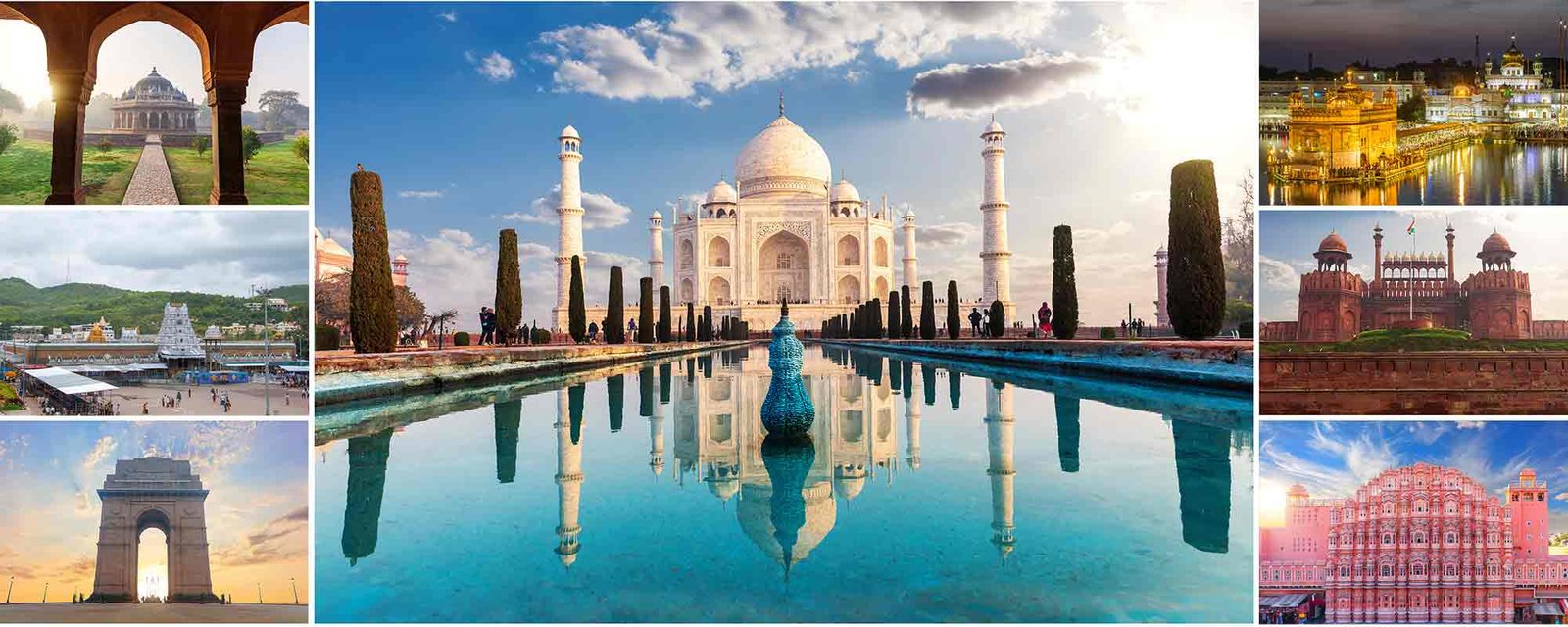
Most international flights land in Delhi, making it the natural starting point for a first trip. The capital is really two cities in one: Old Delhi, with its Mughal-era lanes, spice markets, and the towering Jama Masjid, and New Delhi, home to colonial-era boulevards, government buildings, and leafy diplomatic enclaves.
First-time visitors to Delhi should prioritize:
- Red Fort (Lal Qila) — the red sandstone fortress that once housed Mughal emperors
- Humayun’s Tomb — an early example of Mughal garden-tomb architecture and a precursor to the Taj Mahal
- Qutub Minar — a 73-meter minaret dating back to the 12th century
- Chandni Chowk — Old Delhi’s chaotic, delicious market street, best explored on foot or by cycle rickshaw
- India Gate and Rajpath — the ceremonial heart of New Delhi
Give Delhi at least two full days. It’s noisy, dense, and can be a lot to absorb straight off a long-haul flight, but it sets the historical context for everything you’ll see afterward in Agra and Jaipur.
2. Agra — Home of the Taj Mahal
No list of the best places to visit in India is complete without Agra, and no first-time trip to India is complete without seeing the Taj Mahal in person. Built by Emperor Shah Jahan in the 17th century as a mausoleum for his wife Mumtaz Mahal, the Taj Mahal is one of the most recognizable buildings on Earth — and photographs genuinely don’t do it justice.
The single best piece of advice we give first-time travelers about Agra is this: see the Taj Mahal at sunrise. The monument is at its most magical in the first hour after gates open, when the marble shifts color in the early light and the crowds are at their thinnest. Our Taj Mahal Sunrise Tour from Delhi is designed around exactly this experience — a same-day departure from Delhi timed to get you inside the Taj Mahal complex before the heat and crowds build up, with time afterward to explore Agra Fort and return to Delhi the same evening.
Beyond the Taj, Agra also offers:
- Agra Fort — a UNESCO-listed red sandstone fortress that served as the main residence of Mughal emperors before Delhi’s Red Fort was built
- Mehtab Bagh — a garden across the river from the Taj Mahal offering an alternate sunset viewpoint
- Itmad-ud-Daulah’s Tomb (“Baby Taj”) — often called a draft for the Taj Mahal’s design
3. Jaipur — The Pink City of Rajasthan
From Agra, most itineraries continue west into Rajasthan to Jaipur, nicknamed the “Pink City” for the terracotta-colored buildings of its old quarter. Jaipur is where first-time travelers get their first real taste of royal Rajasthani culture — forts on hilltops, elaborately carved palaces, and bazaars selling block-printed textiles, gemstones, and leather juttis.
Must-see sights in Jaipur include:
- Amber Fort (Amer Fort) — a hilltop fort-palace overlooking Maota Lake, best visited in the morning
- City Palace — still partly home to Jaipur’s royal family, with museums showcasing royal artifacts
- Hawa Mahal (“Palace of Winds”) — the honeycomb-fronted palace that’s become one of the most photographed buildings in India
- Jantar Mantar — an 18th-century astronomical observatory with giant stone instruments
- Jaipur’s bazaars — Johari Bazaar for jewelry, Bapu Bazaar for textiles and juttis
Two to three days in Jaipur is usually enough to see the highlights without rushing.
- Beyond the Triangle: Ranthambore and Fatehpur Sikri
Once you’ve nailed down Delhi, Agra, and Jaipur, two nearby destinations consistently make it onto every serious list of best places in India for travelers who want to go slightly deeper than the standard circuit.
- Ranthambore National Park — Tiger Country
If wildlife is on your bucket list, Ranthambore is one of the best places in India to see a wild Bengal tiger in its natural habitat. Located in eastern Rajasthan, roughly midway between Jaipur and Agra by road, Ranthambore National Park is one of India’s largest and most famous tiger reserves, set against the dramatic backdrop of a 10th-century fort rising out of the forest.
A typical Ranthambore visit involves two safari drives (morning and afternoon) in open jeeps or canters through the park’s core zones. Even if you don’t spot a tiger — sightings are never guaranteed in the wild — you’ll likely see sambar deer, langurs, crocodiles, and an extraordinary range of birdlife, all set against the ruins of Ranthambore Fort. Many first-time travelers add a two-day Ranthambore extension to their Golden Triangle trip specifically for this reason; it’s one of the easiest ways to combine heritage sightseeing with a genuine wildlife experience in a single trip.
- 5. Fatehpur Sikri — The Abandoned Mughal Capital
Just 40 kilometers from Agra sits Fatehpur Sikri, a red sandstone city built by Emperor Akbar in the 16th century to serve as the Mughal capital — and abandoned within 15 years, reportedly due to water shortages. What’s left today is a remarkably well-preserved ghost city of palaces, courtyards, and mosques, including the enormous Buland Darwaza gateway and the Jama Masjid, which houses the tomb of Sufi saint Salim Chishti.
Fatehpur Sikri makes an easy half-day stop on the drive between Agra and Jaipur, and it’s consistently rated one of the most atmospheric, least crowded UNESCO sites on the entire northern India circuit — a good option for travelers who want a heritage experience without the Taj Mahal-level crowds.
Beyond North India: Other Destinations Worth Considering
While the Golden Triangle plus Ranthambore and Fatehpur Sikri covers the essentials for a first trip, India rewards travelers who have a little more time. If your schedule allows for a second visit — or a longer first trip — these regions regularly appear on lists of the best tourist places to visit in India:
- Varanasi — one of the oldest continuously inhabited cities in the world, where the daily Ganga Aarti ceremony on the riverbanks is one of India’s most moving cultural experiences.
- Udaipur — the “City of Lakes,” known for the City Palace complex and Lake Pichola, often considered the most romantic city in Rajasthan.
- Kerala’s Backwaters — a network of lagoons and canals in South India best explored aboard a traditional houseboat, offering a slower, greener contrast to the north.
- Goa — India’s beach capital, with Portuguese colonial architecture, laid-back beach towns, and a nightlife scene that’s popular with international travelers.
- Rishikesh and Haridwar — twin holy towns on the Ganges in the Himalayan foothills, popular for yoga retreats, river rafting, and evening aarti ceremonies.
- Mumbai — India’s financial capital and the heart of the Bollywood film industry, with colonial-era architecture along Marine Drive and the Gateway of India.
- Ladakh — a high-altitude desert region in the Himalayas known for Buddhist monasteries, dramatic mountain scenery, and some of the world’s highest motorable passes.
For travelers who want to see how these destinations can be combined into a longer circuit, or paired with the Golden Triangle, it’s worth browsing our full range of India tour packages, which cover everything from short heritage tours to multi-region itineraries.
Best Time to Visit India for a First Trip
Timing matters enormously in India, where climate varies from Himalayan cold to Rajasthani desert heat. For the classic Delhi–Agra–Jaipur–Ranthambore circuit, the ideal window is October through March, when daytime temperatures are comfortable (roughly 15–28°C) and skies are generally clear. Within that window:
- October–February offers the coolest, most pleasant weather — ideal for walking tours of forts and palaces.
- December–January can bring cold, foggy mornings in Delhi and Agra, which occasionally delays early sunrise viewings of the Taj Mahal, so build in some flexibility.
- March is warmer but still comfortable, and tends to have fewer crowds than the peak December holiday season.
Avoid April through June if possible, when North India experiences intense heat (often exceeding 40°C), and be aware that the monsoon season (July–September) brings heavy, unpredictable rainfall to much of the country, though it can be a beautiful time to visit Kerala.
Practical Tips for First-Time Travelers to India
A little preparation goes a long way in India. Here’s what we tell every first-time client before they travel:
Visa and entry requirements: Most international travelers need a visa to enter India. The e-Visa system is the simplest option for tourists from eligible countries and can typically be arranged online in a few days — apply at least a week or two before departure to avoid last-minute issues.
Getting around between cities: The Delhi–Agra–Jaipur circuit is well-served by private car transfers, the semi-high-speed Gatimaan Express train (Delhi to Agra in under two hours), and domestic flights for longer hops. For a first trip, a private guided tour with a fixed vehicle and driver removes most of the logistical uncertainty and lets you focus on sightseeing rather than navigation.
Money and payments: Carry a mix of cash (Indian Rupees) and cards. UPI-based digital payments are ubiquitous in cities but less useful for foreign travelers without an Indian bank account, so don’t rely on it as your primary payment method.
Dress and etiquette: Dress modestly when visiting religious sites — shoulders and knees covered is a safe rule of thumb. Shoes come off before entering most temples and some historic sites. A respectful, unhurried attitude goes a long way, especially in crowded markets and at religious ceremonies.
Health precautions: Drink bottled or filtered water, and ease into local food gradually if you’re not used to spice. Consult a travel clinic about recommended vaccinations before your trip.
Bargaining: Haggling is expected in markets and with unmetered transport, but not in fixed-price shops, restaurants, or with your tour operator’s quoted rates.
Sample First-Timer Itinerary: 7 Days, Golden Triangle + Ranthambore
For travelers who want a concrete starting point, here’s a proven structure we use for first-time clients:
- Day 1–2: Delhi — arrival, Old and New Delhi sightseeing
- Day 3: Agra — drive from Delhi (or take the Gatimaan Express), Taj Mahal at sunrise, Agra Fort
- Day 4: Fatehpur Sikri to Jaipur — stop at Fatehpur Sikri en route, arrive Jaipur by evening
- Day 5: Jaipur — Amber Fort, City Palace, Hawa Mahal, local bazaars
- Day 6: Ranthambore — drive to Ranthambore, afternoon safari
- Day 7: Ranthambore to Delhi/departure — morning safari, drive back to Delhi for departure
This structure hits every destination covered in this guide while keeping daily travel times manageable — no single driving day exceeds roughly five to six hours.
Frequently Asked Questions
What are the best places to visit in India for first-time travelers?
For most first-time visitors, the Golden Triangle of Delhi, Agra, and Jaipur — combined with a wildlife stop at Ranthambore National Park and a heritage stop at Fatehpur Sikri — offers the most complete, manageable introduction to India’s history, architecture, and culture.
How many days do you need for a first trip to India?
A minimum of 7 days is recommended to comfortably cover Delhi, Agra, Jaipur, and Ranthambore without excessive rushing. Trips of 10–14 days allow for additional destinations such as Udaipur, Varanasi, or Kerala.
Is Agra or Jaipur better for a first-time visitor?
They serve different purposes and are usually visited together rather than instead of one another. Agra is essential for the Taj Mahal and Mughal architecture, while Jaipur offers Rajasthani palaces, forts, and a livelier shopping and market experience.
What is the best time of year to visit the Taj Mahal?
October through March, with early morning visits year-round offering the softest light, thinnest crowds, and coolest temperatures — which is why sunrise tours from Delhi are so popular among first-time visitors.
Do I need a guide to visit India’s top tourist places?
It isn’t mandatory, but a licensed local guide significantly improves the experience at sites like the Taj Mahal, Agra Fort, and Amber Fort by providing historical context that isn’t always available on-site signage, and a guided tour also removes most transport and logistics stress for first-time visitors.
Is Ranthambore worth visiting on a first trip to India?
Yes — Ranthambore is one of the most accessible tiger reserves in India from the Golden Triangle circuit, making it easy to add a genuine wildlife safari experience to a heritage-focused itinerary without significant extra travel time.
Plan Your First Trip to India with Confidence
Choosing the best places to visit in India doesn’t have to be complicated. For most first-time travelers, the winning formula is straightforward: start with the Golden Triangle of Delhi, Agra, and Jaipur, add Fatehpur Sikri and Ranthambore if you have the time, and build in enough flexibility to actually enjoy each stop rather than rushing between them.
As an experienced India tour operator, India Tour Organiser designs itineraries specifically around this kind of first-time-friendly pacing — private transport, sunrise access to the Taj Mahal, and guided visits to every major site on this list. If you’re ready to start planning, take a look at our Taj Mahal Sunrise Tour from Delhi as a starting point, or browse our complete range of India tour packages to build a longer circuit around the destinations covered in this guide.